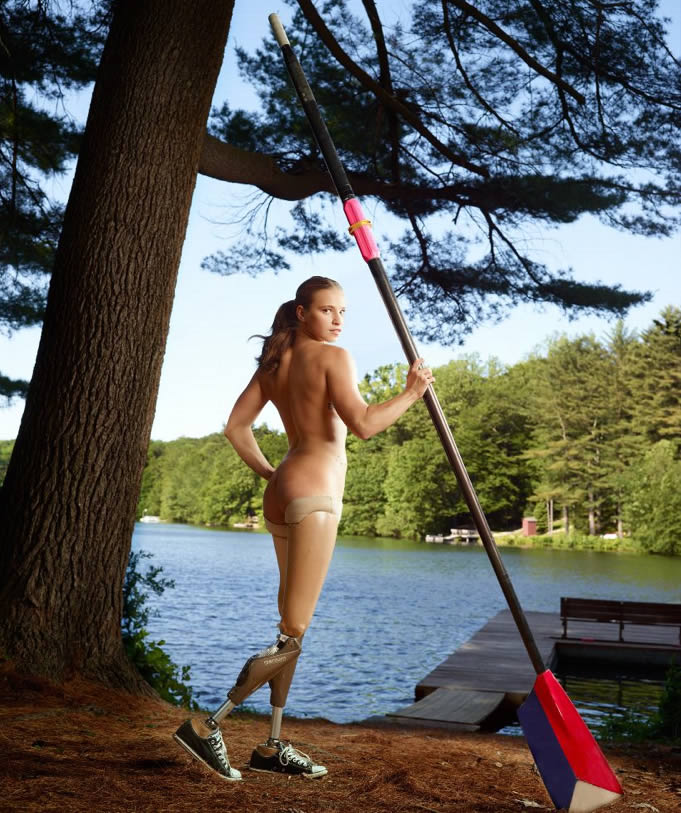
A gallery of striking portraits of olympian atheletes. Of all the sculpted bodies in the gallery, Oksana Masters’ picture goes beyond the power of the body, to the power of the mind, and probably redefines the body itself for the modern age.
Growing up in a very poor orphanage in Ukraine, there wasn’t much food. I can go days without eating if I don’t think about food. Your mind, to protect itself, learns not to pay attention to that hunger feeling. That’s why for me, eating is one of the hardest things.
A TED talk at its best. Bryan Stevenson on Incarceration and Injustice.
At TED’s flagship conference this past spring, in Long Beach, California, Bryan Stevenson, who heads the Equal Justice Initiative, took to the stage to give a TED talk for the first time. He prepared less exhaustively than many TED presenters do: he told me that he’d planned his remarks in large part on the flight over. (Stevenson, whose work included arguing Miller v. Alabama before the Supreme Court later that month, had a busy spring.) Yet his lecture was a perfect expression of everything a TED talk, at its best, achieves. Stevenson approaches an issue of national concern—in this case, hidden prejudices and injustices of America legal procedure—through a series of personal stories, giving the issue a warm emotional valence. As the talk drew to a close, you could feel excitement gathering in the Long Beach theatre; when Stevenson finished, he received a long, ecstatic standing ovation—the biggest of the conference. Many veteran TEDsters call this kind of thrill a “TED moment.”
This was one of Five Key TED Talks listed by Nathan Heller at the New Yorker.
Science blog ‘Empirical Zeal’ had a lovely two part blogpost on Colour, “How we gave colors names, and it messed with our brains“, brilliantly done here and here, which went on to win the top prize for best science blogpost 2012 at 3quarksdaily.
It included this video, of a Namibian tribe called the Himba, and their unique take on colour. For example, to the Himba, the Sky is black, water is white, and milk is also white. The video is part of a BBC documentary on colour. Be sure to watch the whole video.
A couple of things struck me watching this video…
What makes us think they’re describing colour according to our definition of colour?
We are surprised at their way of seeing colour. Thats only because we dont know their way of looking at colour. Any art academic will tell you those are two different things.
Maybe their culture and history doesn’t bring them to need to describe as many colours as we historically and slowly came to do?
This led to a chain of speculation on my part. What if they’re not using the words in their language to describe the spectral position of the colour – which is what we do when we teach our children the colours of the rainbow – but something else as well, that we see but English disregards as ‘not color’?
In the modern world, we have a comprehensive and exact definition of what constitutes a colour in our language, and how we describe the world with those and other words.
Now while we have 11 words for colours, the Himba have half that. What if they’re not describing just colour, but colour+X of any object?
How else to understand the Himba describing the Sky as black, and water as white, AND milk as white, while in English we call water AND sky blue, and milk white?
Assuming the Himba have the same eyes as every other human on the planet, we can see exactly what they can see.
In which case, perhaps while we took the direction of making our language describe spectrum position, to the Himba color is an overlap of spectrum position and another Category:
physical property? (liquids vs air – water is white, sky is black – what colour is the earth to the Himba?)
context and meaning of the object in their life? (Water is white, milk is white – both are sustaining liquids?).
iridescence? saturation?
living quality – living, biological product or source, non-living..
location – above/below the horizon?
a combination of things?
One important thing to remember – even these few *categories* are constructs of our language and culture, that may not be the same as theirs.
Water is white, milk is white, sky is black. Our mind hurts.
It is truly lost in translation. Their white is NOT our white, when we try to describe milk.
I’m sure poets would understand this language much better – not because its poetic, but because it probably mixes categories.
Think of Synesthesia. We tend to see the sensory conflation of physical experience and visual stimulus as an ‘odd’ thing – a mutation, or defect. What if the Himba’s language integrates that as a natural way to see the world?
This could also explain why the processing of colour in the human brain jumps from the visual to language centers of the brain, from right to left hemisphere as we grow up. Words are fixed definitions of physical properties, contexts and interactions. Once defined, we offload processing to the ‘definition’ areas of our minds that tell us what we are seeing. Think of how a child or poet or illustrator can describe or draw a ‘curly’ head of hair as ‘bubbly’. The child has not yet learnt the categories, and artists routinely mix categories
I’d write more, but i’m getting into armchair speculation, at best, and I don’t dare.
If I could I would question the Himba to discover categories they may describe, beyond our own definition of ‘colour’.
Do they call the sky black because they’re describing its natural colour at night, before the ‘white’ sun comes out? Maybe they see the day sky and night sky as two different things entirely, unlike us, and they see the sun as a white sheet/dome that covers the black sky?
How do they describe a shadow?
How do they describe a rainbow – how many colours do they see?
what colour is blood? As a life sustaining liquid, is it ‘white’, they word they use for water and milk?
what colour is the earth to the Himba? What colour is excrement? one is fertile, red in Africa, the other is waste.
With all the doom and gloom about the economy these past few years, someone on the forum Reddit.com asked a very valid question –
“Where has all the money in the world gone?
I hear nothing but bad news about financial crisis all over the world, and it seems that there is a shortage of cash – like it is some sort of natural resource.
People haven’t stopped buying stuff. They still need food, clothing, medicine, shelter. Taxes are still collected. Fines are still levied.
So where is all the money? I mean, labor has been produced to make things and wages paid to the laborers. The things are purchased by other laborers, who were paid for producing goods or services, etc. It’s a closed loop, right?
Can someone explain it like I’m five or something?”
Reddit user ‘otherwiseyep’ came to the rescue with a long but simple explanation. Short answer: money is a simple idea, but it gets complicated fast the more people use it in new and different ways.
Before there was Facebook, there was the Telegram, and before that, in 17th Century Oxford, there were shops that sold ‘that Muslim drink, Coffee’, and kept the students from their studies. Its all too familiar.
Enthusiasm for coffeehouses was not universal, however, and some observers regarded them as a worrying development. They grumbled that Christians had taken to a Muslim drink instead of traditional English beer, and fretted that the livelihoods of tavern-keepers might be threatened. But most of all they lamented that coffeehouses were distracting people who ought to be doing useful work, rather than networking and sharing trivia with their acquaintances.
When coffee became popular in Oxford and the coffeehouses selling it began to multiply, the university authorities objected, fearing that coffeehouses were promoting idleness and diverting students from their studies. Anthony Wood, an Oxford antiquarian, was among those who denounced the enthusiasm for the new drink. “Why doth solid and serious learning decline, and few or none follow it now in the university?” he asked. “Answer: Because of coffee-houses, where they spend all their time.”
One of the best talks i’ve seen about how new technology affects us, and what really matters about this thing called ‘community’ – from a woman at the center of it all. Must see.

 S.A.R
S.A.R 